張瑞釗 Chang Reed-Joe
Act well your part for those who love you, and those who don't will start loving you.
國中英語釋疑
《漫話細說 ChatGPT:教學系列》
── 國中英語釋疑
ChatGPT: Talking Softly, Exploring Deeply ─ Teaching Series
Explaining Junior High School English
這是七年級英語課本的一個句子:
「Thanks to this, Bali now uses its plastic bags again and again.」(多虧於此,峇里島現在重複使用它們的塑膠袋。)
作者原本的中文意思是對的:「多虧這項行動,峇里島現在會重複使用塑膠袋。」然卻將英文寫成:
“Bali now uses its plastic bags again and again.” — 「多虧了這項行動,峇里島現在一再使用它們的塑膠袋。」
顯然,語意上變成:「峇里島現在反而更頻繁地使用塑膠袋」── 和課文中所介紹的 “Bye Bye Plastic Bags” 清理海灘活動的本意背道而馳。該活動是為了減少使用塑膠袋,而不是鼓勵一再使用塑膠袋。
不過,在課本同一頁 (P. 90) <Think and Check> 中,就寫對了:
“Keep plastic bags and use them again and again.“
(峇里島現在保留塑膠袋,並一再使用它們。)

或譯為:
“Thanks to this, Bali now reuses plastic bags regularly.“
(多虧這項行動,峇里島現在規律地重複使用塑膠袋。)
若要符合7年級英語層級字彙規範及課本原句,則可譯為:
“Thanks to this, Bali now uses each plastic bag again and again.“
如此才能真正表達這篇文章的原意。
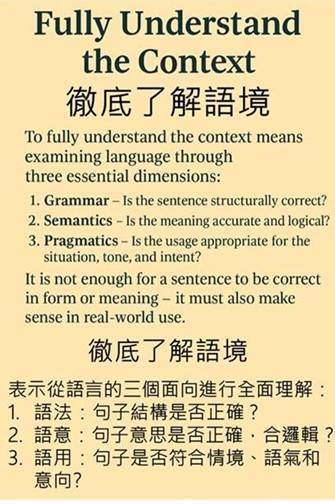
以上為英語教學「Fully understand the context」(徹底了解語境)一個很好的例子。真正了解語境,必須從三個面向切入:語法(grammar)是否正確,語意(semantics)是否準確,語用(pragmatics)是否符合真實情境(如圖所示)。
然而,這三個面向的背後,其實建立在一個更根本的能力上 ── 語言邏輯的直覺查覺能力。也就是說,在討論語法、語意、和語用之前,我們應該更要本能地察覺句子在邏輯上是否不通。這個句子的誤譯,不是英語能力的問題,而是基本邏輯的問題 ── 不論就哪一種語言而言,語意都是不通的。作者或編輯在撰寫或審稿時就應該察覺。
雖然這個句子的語法是對的,但是語言邏輯顯然錯誤在先,語意跟著就錯了。因此,英語教學,只求語法正確是不夠的。 “use… again and again” (一再使用) 的意思,並不等同於 “reuse” 或 “keep…and use…again and again”(重複使用),這是語言邏輯的問題 ── 無論在中文或英文中,「一再使用」絕不等同於「重複使用」(詳見《知識應基於真實》一文)。何故?請看這句話便知端倪:
我們不可以一再地使用塑膠袋。
➤ We should not use plastic bags again and again.
原來,“again and again”(一再)通常出現在否定語境中,用以強調「不應反覆做某事」,帶有負面評價。在語用上,它常表示過度、濫用、不當的重複。這種用法,在許多語言中皆相通,並非英語獨有。
可惜的是,類似這樣的例子在國內屢見不鮮,尤其當教材出自非母語人士或本地機構時更常發生。因此,若教材內容要作為考題使用,尤其是在段考、模擬考、會考、甚至學測中,務必要小心查證與謹慎審查。
第3次段考即將到來,建議若要將此句(第90頁這個句子)以任何方式納入考題,務必要回歸原文正確的涵意與邏輯,以避免題目爭議,也不致誤導學生。
延伸閱讀:《知識應基於真事》
🟦 English Translation:
Clarification of the Last Sentence on Page 90 in 7th Grade English
The last sentence on page 90 of the 7th grade English textbook reads:
“Thanks to this, Bali now uses its plastic bags again and again.”
The original intended meaning in Chinese is actually correct:
“Thanks to this initiative, Bali now reuses plastic bags.”
However, the English version was written as:
“Bali now uses its plastic bags again and again,” which translates to:
“Thanks to this initiative, Bali now uses its plastic bags over and over again.”
This clearly shifts the meaning to: “Bali is now using plastic bags more frequently than before,” which is entirely contradictory to the original intent of the “Bye Bye Plastic Bags” campaign mentioned in the passage. That campaign aims to reduce the use of plastic bags, not to encourage their repeated use.
Therefore, a more accurate, logically sound, and context-appropriate version would be:
“Thanks to this, Bali now reuses plastic bags regularly.”
(This means: “Thanks to this initiative, Bali now regularly reuses plastic bags.”)
Only this version accurately conveys the intended message of the passage.
The above serves as a strong example of the importance of the English teaching principle:
“Fully Understand the Context.”
To truly understand context, we must evaluate a sentence from three essential dimensions:
- Grammar – Is the structure correct?
- Semantics – Is the meaning accurate and logical?
- Pragmatics – Is the usage appropriate for the real-world situation?
(as illustrated in the accompanying chart)

However, beneath these three dimensions lies an even more fundamental ability —
an instinctive awareness of logical coherence in language.
In other words, before discussing grammar, semantics, or pragmatics, one must first be able to intuitively recognize whether a sentence makes logical sense.
This mistranslation is not simply a problem of English ability; it is a matter of basic logic.
Regardless of the language, the meaning is logically incoherent. The author or editor should have recognized this during the writing or editing process.
Although the grammar of this sentence is technically correct, the logical flaw comes first, and the semantic misunderstanding follows.
Therefore, in English education, grammatical correctness alone is not enough.
Secondly, it is because the meaning of ‘use… again and again’ was not fully understood; this phrase does not actually mean ‘reuse.’
Unfortunately, examples like this are all too common in Taiwan, especially when teaching materials are written by non-native speakers or local institutions.
For this reason, if such materials are to be used in tests — particularly in midterms, mock exams, or even official assessments — they must be carefully reviewed and verified.
As the third-term exam approaches, it is strongly recommended that if this sentence (from page 90) is to be included in any form of assessment, it must first be revised to accurately reflect the original meaning and logical intent — to avoid confusion, controversy, and the risk of misleading students.